Reusable immutable delivery
Shared CI/CD builds immutable images with SBOM and provenance, then performs rollout-safe deployment updates and rollback.
Master architecture
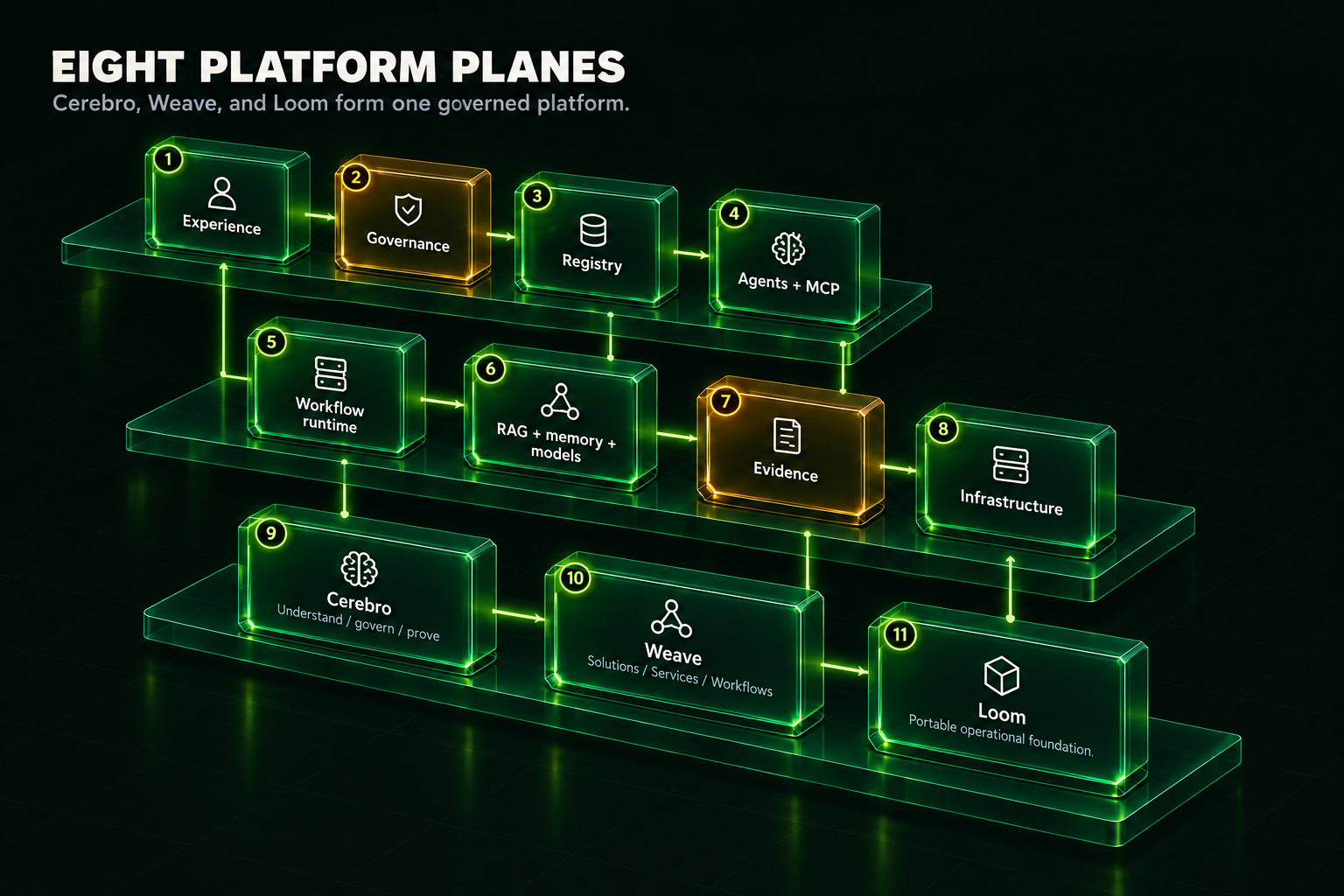
This is the approved top-level ContextWeaver architecture: Experience, Governance, Registry, Agents + MCP, Workflow runtime, RAG + memory + models, Evidence, and Infrastructure are coordinated by Cerebro, Weave, and Loom.
The eleven components preserve the approved platform hierarchy, trust boundaries, and portable infrastructure relationship without changing the architecture model.
Interactive platform architecture
Use Play, Pause, Previous, Next, Reset, stage selection, or component inspection to explore the same eleven-component model shown above.
Motion follows the active route only. Labels, captions, line styles, and stage controls keep the approved architecture readable when animation is paused or reduced.
19-page technical atlas
Move through layered architecture, deployment, identity, durable execution, RAG, recovery, authorization, operations, and an OpenTelemetry run trace explorer without switching visual systems.
All 19 pages use photoreal rendered-glass masters with exact semantic overlays. The trace explorer follows W3C context across browser, gateway, policy, workflow, Agent, MCP, model/RAG, queues, stores, and external side effects.
Detailed architecture explorers
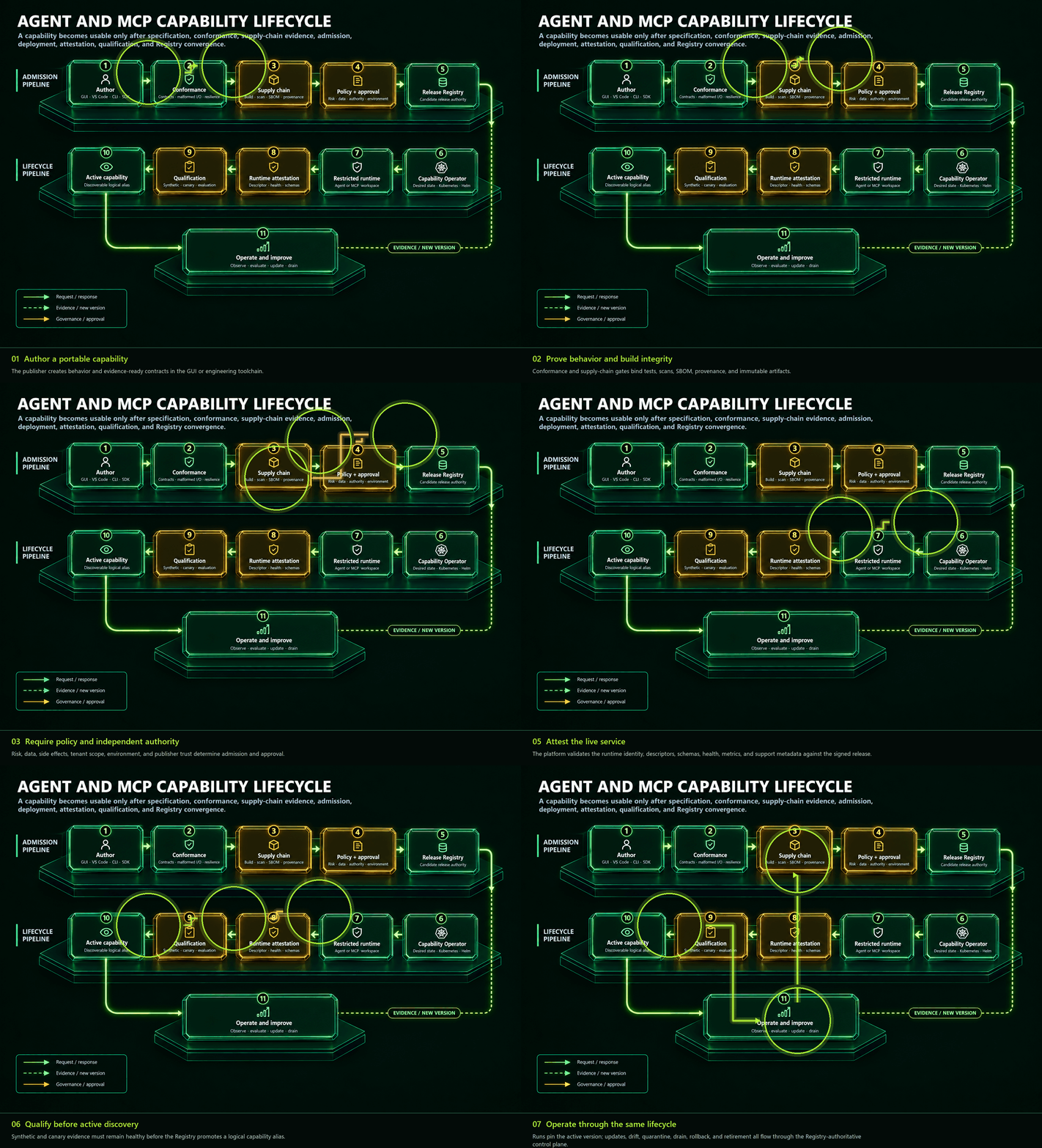
The diagrams below preserve the same product semantics and focus separately on capability lifecycle, governed runtime, and scale.
Interactive diagrams
Every player supports Play, Pause, Next, Previous, Reset, stage selection, component inspection, keyboard focus, reduced motion, and a textual explanation.
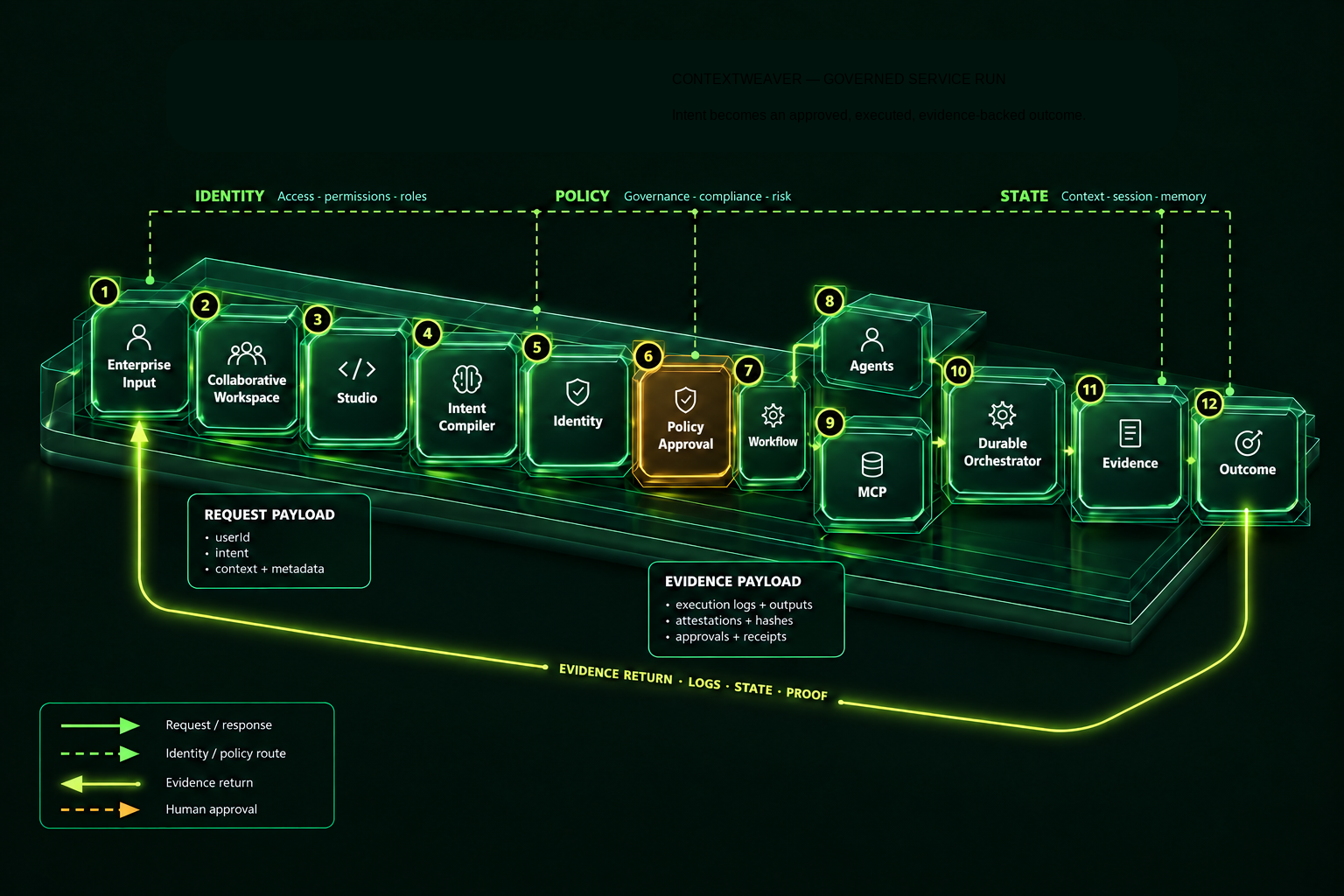
Seven governed stages move across three receding architectural planes from authenticated intent to a reviewable, replayable result.
Deployment is not discovery: a capability becomes usable only after runtime attestation, Registry convergence, and qualification.
The player shows how a user-facing Solution action resolves a reusable Service, identity and policy paths, parallel Agent work, MCP side effects, human approval, durable state, and final evidence.
Stable capability contracts remain portable while governance, tenancy, isolation, deployment, and assurance become progressively stronger.
Cloud and deployment posture
ContextWeaver separates the cloud-neutral control-plane design from the qualification of a specific provider profile. “Target adapter” means the contract is designed; it does not claim production parity.
| Capability | Azure | AWS | Google Cloud | Private / sovereign |
|---|---|---|---|---|
| Kubernetes runtime | AKS | EKS target | GKE target | Conformant Kubernetes |
| Workload identity | Active adapter | Target adapter | Target adapter | Profile-specific |
| Secrets | Key Vault adapter | Secrets Manager target | Secret Manager target | Native / OpenBao target |
| Object and durable state | Active realization | Target adapters | Target adapters | PostgreSQL + S3-compatible profile |
| Search and retrieval | Active realization | OpenSearch target | Search/vector target | OpenSearch / Qdrant target |
| Model providers | Azure OpenAI adapter | Bedrock target | Vertex AI target | OpenAI-compatible local target |
| Observability | OpenTelemetry, Prometheus, Grafana, logs, traces, metrics, and provider-specific export adapters | |||
| Current posture | Active realization | Target profile | Target profile | Profile-dependent |
Current deployment baseline
The local and Azure realization now includes repaired Keycloak entry, governed MongoDB workspace access, and reusable immutable CI/CD with SBOM, provenance, rollout-safe updates, and rollback.
Shared CI/CD builds immutable images with SBOM and provenance, then performs rollout-safe deployment updates and rollback.
The public Keycloak login path is restored, and governed MongoDB workspace access uses controlled identity and secret-reference boundaries.
MCP-capable clients use delegated user identity, identity-filtered discovery, purpose and policy context, and platform-owned upstream credentials through the capability gateway.
Portable assets
The editable source contains one Draw.io page per diagram. Static SVG works for print and documentation; GIF works when an interactive player is unavailable.
Four pages with semantic colors, orthogonal connectors, grouped boundaries, and stable component names.
Download .drawio →Deterministic stages, component details, manual controls, accessible captions, and reduced-motion behavior.
Open a player →Responsive vector fallback with all components and labels visible when animation or scripting is unavailable.
Open SVG →Meaningful stages at one second per frame, optimized for readability rather than decorative speed.
Open GIF →Product truth
The website intentionally distinguishes implemented foundations, active realization, and target architecture. Readiness must be demonstrated for the exact release, deployment profile, risk tier, cloud, region, and customer control environment.
Final chapter
Explore the curated briefs on security, identity, runtime resilience, RAG, observability, cloud neutrality, and deployment readiness.